Sunday, 22 November 2015

Ghanaian Academia Participation in Nation Building: A Conundrum

The Member of Parliament (M.P.) for Sekondi, Mr. Kobby Otchere-Darko has accused Ghanaian academia of apathy, when it comes to nation building. The M.P. believes that a cross-section of academia could contribute constructively to national issues, but they remain quiet and allow the politician to assume more than the necessary powers, sometimes creating chaos for the nation.
I share the sentiments of the M.P but only to an extent. Whilst it is a fact that all hands must be on deck for maximised national benefits, academia does not necessarily have to be in the limelight of politics in order to contribute. The collaboration between government and academia could be constantly effective, as well as smooth, if both parties would operate on transparency and genuinely target national development. After all, academic is expected to research current issues of community and national relevance, then based on empirical evidence, recommend applicable suggestions to policy-makers. Therein lies the challenge.
Every academic and research conference would usually be opened by a minister or a person in a certain key industrial or academic position. The minister or representative would glibly inform delegates that policy-makers expect strong recommendations from the meeting. Sometimes, getting same representatives to close such meetings becomes a challenge. What is crystal clear is that recommendations from such proceeding are simply shelved by the ministers or sections which receive such, because very workable suggstions are not implemented or factored into various national development agenda. Yet that is just a part of the problem.
Research has become a major tool for national development, because it helps to thoroughly unravel issues. Serious nations have explored quality research to make inroads into crucial socio-cultural and geo-political issues, the benefits of which serious investigations are being enjoyed globally. Africa is a major beneficiary of global research, and one continues to hope that the countries therein will muster their resources and focus on research in order galvanise local solutions to African problems. A utopia!
Whereas other communities pump huge sums of money into research activities, African countries squander resources on triviality, especially four-wheeled vehicles we neither can manufacture nor effectively maintain. The discrepancy between funding for research in some of our partner countries and that of Ghana is simply pathetic, ludicrous! The discrepancy is the singular proof that this nation pays lip service to research. Typically, Ghana waits for simple issues to degenerate into chaos, then it begs outsiders to fund research. Yet, other issues exist.
Due to the concept of publish or perish among academia, research activities are on the increase. It is a fact that mediocre, and sometimes, sub-standard work is paraded as research by some academia, but there is also evidence of appreciable quality research. If Ghana genuinely sought recommendations to existing problems, it could find effective ones among researchers in Ghana, which brings me back to the sentiments expressed by the M.P.
If various research recommendations were studied and thoroughly analysed for applicability, policy-makers would be aided in handling community and national issues. There are so many projects initiated by students and academia across all learning disciplines in Ghana. Very promising projects .are locked-up in various departments and store rooms, or shelved by government agencies because neither institution nor government is interested in furthering the research. Yet, some border on critical issues such as energy conservation, recycling, solar energy, health, better learning approaches, to name five.
Ironically, academia is not even listed among key stakeholders of the 40-year Development Plan currently being trumpeted. When the host of GTV’s Talking Point questioned Dr. Nii Moi Thompson about the absence of academia, the latter answered that academia was counted among civil societies. That is not accurate. That Ghana could consider such a long-term national plan without actively involving academia is such a slight, and a telling proof of how the policy-maker belittles education and academia! In contrast, Mr. Otchere-Darko’s sentiments imply his regard for academia; I am quite sure that he would back the inclusion of academia in the stakeholders. 
Academia is not simply apathetic, at least not all of them. But it is the height of frustration to research issues, offer radical recommendations, suggest very workable remedial strategies and continuously be ignored by policy-makers who rather opt for intrepid adhoc solutions. If governments and other stakeholders genuinely desire the co-operation of academia in Ghana, they should bond through research. Government should begin by budgeting realistically for multi-disciplinary research. It should task academia to plunge into applied research for all the ailing critical situations of the country. Most importantly, government must implement the most effective and progressive recommendation from academia. I count on M.P. Otchere-Darko to support academia.
It would be refreshing indeed, if government would strategise through research and explore holistic and sustainable solutions for national crises! Dare we hope?

Thursday, 30 October 2014

Sanitation at all Times!


The two-story building consists of nine flats. They have a twenty-one day cleaning cycle where a flat sweeps the house twice in three weeks. Every Saturday, the three flats on every floor do group cleaning; they sweep and scrub the main drain in the house. Whist two floors do their utmost to honour the cleaning arrangement, one floor continues to flout the plan, one flat insisting that they do nothing on the ground ,floor. Apparently, pounding Fufu downstairs and having their waste water pass down the main drain count not. One flat just refuses to clean, and they have young children.
With attitude like  that one cannot be surprised that Ghana has been engulfed by filth and has over the years been overwhelmed by the cholera disease. It is sad yet comical that in the twenty-first Century, a nation has to declare a sanitation day in an effort to get residents to clean their surroundings. The waste situation in Ghana is a stark proof that the nation moves backwards rather than forward. Over the last four centuries, we have successfully shirked our cleaning responsibilities, domestically and publicly. 
Ghanaians have developed deplorable attitude to cleanliness; many simply refuse to practice clean lifestyles. Both literates and illiterates are guilty of creating and living in dirty surroundings. Even the basic acts of sweeping, dusting and scrubbing their own homes have become chores so much that many simply neglect such healthy activities. An equally abysmal situation pertains in public spaces. Metropolitan and District Assemblies are overwhelmed by waste—domestic as well as industrial; despite some attempts at managing waste, cities and towns are engulfed by filth. Throughout the country, gutters have become dumping sites for feces and solid waste; they have thus degenerated from drains to health hazards in various communities. But the problem goes far beyond abused drains.  

Some home owners fail to provide places of convenience and proper drainage systems, creating opportunity for free range defecation, indiscriminate disposal of liquid waste which pollute the air and create stagnant waters: such situations compromise people’s health. The offending owners design every available space within their buildings as living rooms, to the exclusion of washrooms and other living conveniences, forcing tenants to use public places or surrounding lands as places of convenience. About “six million Ghanaians practice open defecation because they have no access to toilet facilities”. The offenders, representing “twenty percent” of the Ghanaian population, apparently do not know the “health implications” of their actions. Such home owners neither bother to create proper outlets for liquid waste. Water usually collects at the back of the house or runs under neighbours’ walls, defacing property, polluting the environment and again, compromising residents’ health. The danger is that an appreciable number of Ghanaians continue to replicate such unhealthy building patterns.
Many Ghanaians have become so insensitive to filth that they wallow in it and gladly add to it. People--young and old, lettered and unlettered, male and females—litter streets rather than leave rubbish in garbage bins. Granted, metropolitan and district assemblies fail to provide adequate bins for public places in the country. However, sometimes where they are present, irresponsible citizens would litter the roads rather than walk to garbage bins. Where there are no bins, rather than behave conscientiously, keep the waste till they get home or to a bin, they leave it by the wayside. Our cleaning efforts are similarly problematic.
Metropolitan and District Assemblies are responsible for the general cleanliness of public spaces in the country. Among other functions, they employ people to clean public spaces; they also secure equipment for transportation of garbage from homes and public places to designated dumping sites. That mandate includes proper maintenance of dumping sites to ensure environmental sustainability. Also included in the Assemblies’ duties is enforcing sanitary rules in domestic domains and public spaces.
In the past, Sanitary Inspectors would go round people’s homes to inspect that basic tasks such as sweeping of homes and cleaning of bathrooms, tap areas and animal shelters were properly done to avoid unhygienic conditions that could lead to diseases and death. Similar monitoring was done in commercial areas. Those known duties of the Assemblies have not changed with time. In fact, rapid population growth, rural urban migration, technological advancement and other global trends all have added implications for waste generation, thus adding to the challenges of the mandate of Assemblies as cleaning agents, calling for innovations in waste management. Sadly, the assemblies have not been able to handle waste challenges, hence, the cholera pandemic and the resultant human losses.
Amidst such waste chaos, the Government has initiated a sanitation system where the first day of every month will be dedicated to general cleaning, effective November 1, 2014. The initiative raises apprehension rather than hope for any solution to the waste crisis in the country. The general deplorable attitude of Ghanaians towards safe waste management persists so what good could possibly come out of this initiative? When people fail to honour simple sweeping and scrubbing arrangements in their homes how would they clean the streets? When about twenty percent of Ghanaians have no access to toilet in their homes how will Saturday’s cleaning stop them from defecating indiscriminately? With those gaping gutters scattered across the country, how will people be stopped from throwing rubbish into those drains after Saturday?
For Saturday’s cleaning to be very effective there has to be water. Can the Ghana Water Company assure Ghanaians that water will flow across the country so that all residents will have whatever amounts of water they will need for thorough cleaning? Will the assemblies mobilize its own resources well such that filth can be carried away from neighbourhood dumps or will the usual offensive sight prevail where waste swept will be left at the curb of gutters for the rain or wind to send them right back to the gutters or to homes? This whole sanitation day issue is a joke. The joke of the year!

The most important question. Even if the assemblies overdo themselves and cart the filth away, where will they send them? To the landfills to deface communities and make people sick through the stench? Dump the waste and breed flies who will go to the communities and increase cholera infection? Dump the filth at the landfills and pollute the environment with methane, the third major cause of global warming and go and pray to God for deliverance from the extreme heat?

May the good Lord deliver us from people in  governance who demonstrate laziness and disgusting incompetence through adhoc solutions that multiply problems! Sanitation day, here we come!

Thursday, 22 December 2011

Kitchen Composting

I wrote in the premier posting that "our waste management efforts must match our rate of waste generation". It will take diverse waste management approaches to match both. The good news is that it can be done; it needs individual discipline that can engender real attitudinal change, and commitment. Composting biodegradable waste is a very cheap process which can be utilized in the back yard and in the kitchen. The images below take readers through my kitchen composting, an aspect of my waste management project. The idea is to motivate conscientious Ghanaians to reduce the waste they send out to the landfill. Let us all apply the principles of 5R, as advocated by the Earthworm Interest Group of Southern Africa (EIGSA):
http://www.eigsa.co.za/

Composting in my kitchen

Follow the processes below to start your kitchen compost so you can regenerate biodegradable waste. Anytime a person composts biodegradable waste , the waste sent out to the landfill is reduced, rendering effective our efforts at waste management.
                                                                                                                                                                                                                                        Pic. 1: All  you need is a plastic bin to store your kitchen and carbon waste.


                                              Pic. 2: Bin perforated on top for aeration.


                                                         Pic. 3: Bin perforated underneath for draining


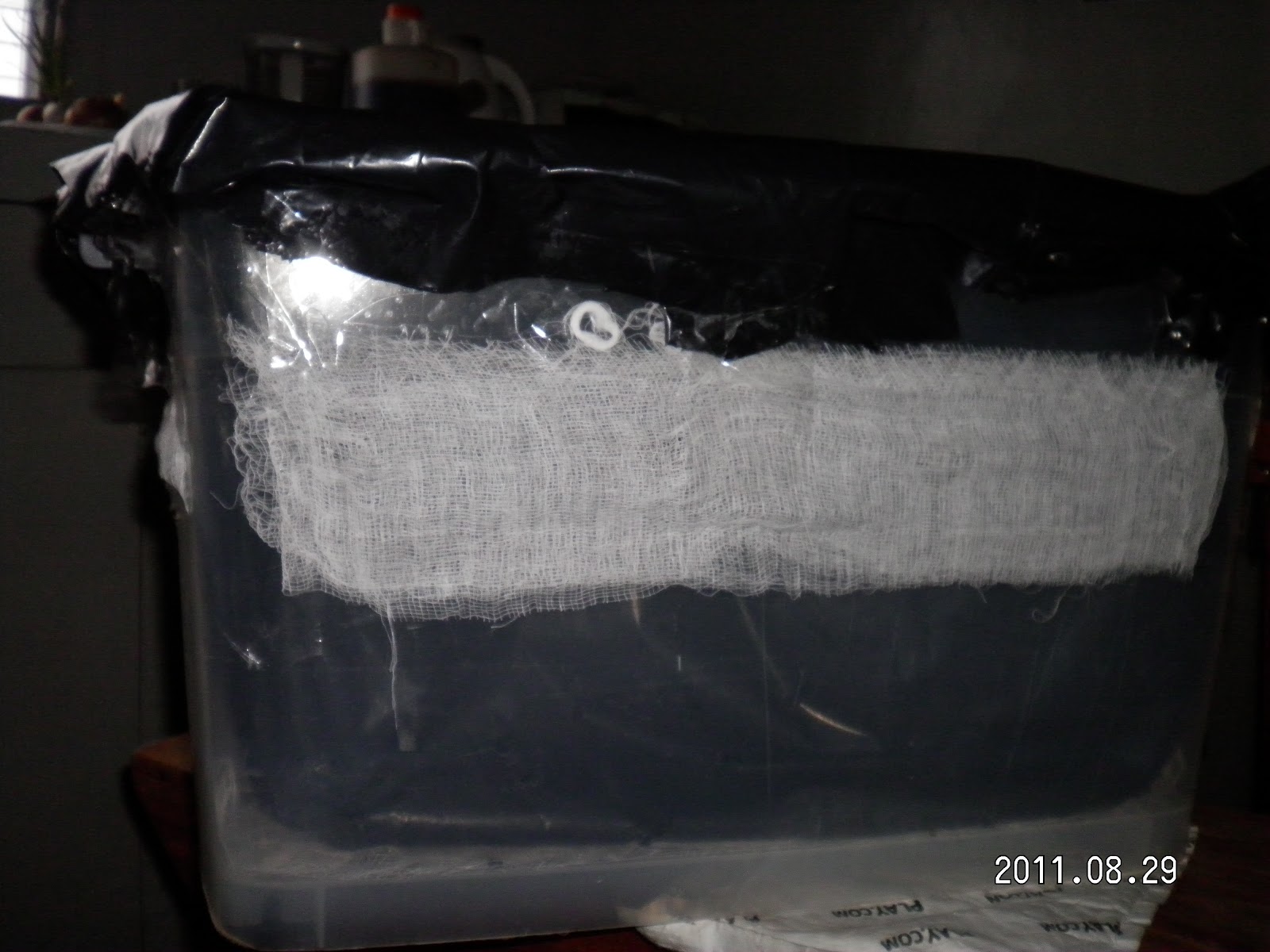
                                               Pic. 4: Perforated holes covered with gauze to prevent invasion by flies.

                                               Pic. 5: Bin lined with durable black polythene. Sand as base for compost.
 
                                               
Pic. 6: Kitchen waste and dry leaves added to the soil                                      

                                     
                                    Pic. 7: Browns--white, brown, tissue and newspaper, sawdust added to waste.
                
                             
                                Pic. 8: Bin covered and placed for draining.                    


                                     Pic. 9: Compost bin under my kitchen sink.
                                   
I have been adding kitchen waste and carbon materials since August. That is my quota in fighting the waste menace in the country.

Start the process i, nurture the waste by providing adequate moisture and heat, whilst adding to the waste, carbon and nitrogen material simultaneously. Leave the rest to nature.

                                Pic. 10: Even in the confines of the a plastic bin, nature works.
Three months later,  there is evidence of decomposition, waste gradually turning into soil.